
The Development of a Chinese Healthy Eating Index and Its Application in the General Population
The Development of a Chinese Healthy Eating Index and Its Application in the General Population
Ya-Qun Yuan et al. Nutrients. 2017.
Abstract
The objective of this study was to develop a Chinese Healthy Eating Index (CHEI) based on the updated Dietary Guidelines for Chinese (DGC-2016) and to apply it in the 2011 China Health and Nutrition Survey (CHNS-2011) to assess diet quality and its association with typical sociodemographic/economic factors. Data from 14,584 participants (≥2 years) from the CHNS-2011, including three 24-h dietary recalls and additional variables, were used to develop the CHEI. The standard portion size was applied to quantify food consumption. The CHEI was designed as a continuous scoring system, comprising 17 components; the maximum total score is 100. The mean, 1st and 99th percentiles of the CHEI score were 52.4, 27.6 and 78.3, respectively. Young and middle-aged adults scored better than the elderly. Diet insufficiency was chiefly manifested in fruits, dairy, whole grains and poultry; diet excess was mainly reflected in red meat, cooking oils and sodium. The CHEI was positively associated with education and urbanization levels; current smokers and unmarried people obtained relative low CHEI scores. Occupation and body mass index (BMI) were also related to the CHEI. Our findings indicate that the CHEI is capable of recognizing differences in diet quality among the Chinese, and it is sensitive to typical sociodemographic/economic factors.
Keywords: China; diet quality; dietary index; general population; sociodemographic determinants.
PubMed Disclaimer
Conflict of interest statement
The authors declare no conflict of interest.
Figures
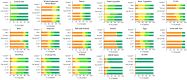 Figure 1
 Proportion of participants in four section scores of the 17 CHEI components, according to the sex and age groups (years). For all components except fruits, sodium and cooking oils, the four sections are 0
gov/23168270/" ref="linksrc=references_link&ordinalpos=2" data-ga-category="reference" data-ga-action="23168270"> PubMedMeSH terms
Grants and funding
R01 HD038700/HD/NICHD NIH HHS/United States R01 HD030880/HD/NICHD NIH HHS/United States D43 TW007709/TW/FIC NIH HHS/United States D43 TW009077/TW/FIC NIH HHS/United States P30 DK056350/DK/NIDDK NIH HHS/United StatesLinkOut - more resources
Full Text Sources
Europe PubMed Central MDPI PubMed CentralOther Literature Sources
scite Smart Citations相关知识
The Development of a Chinese Healthy Eating Index and Its Application in the General Population
Update of the Healthy Eating Index: HEI
Proactive Health: An Imperative to Achieve the Goal of Healthy China
Development and validation of the Chinese Health Literacy Scale for Chronic Care
Association between the Healthy Lifestyle Index and risk of multimorbidity in the Women’s Health Initiative,The Journals of Gerontology Series A: Biological Sciences and Medical Sciences
The impact of comprehensive healthy lifestyles on obstructive sleep apnea and the mediating role of BMI: insights from NHANES 2005
The Health Benefits of Dietary Fibre
Benefits of Sexual Activity on Psychological, Relational, and Sexual Health During the COVID
The Chinese Longitudinal Healthy Longevity Survey (CLHLS)
Health Promotion Board Introduces My Healthy Plate to Inculcate Healthy Eating Habits amongst Singaporeans
网址: The Development of a Chinese Healthy Eating Index and Its Application in the General Population https://www.trfsz.com/newsview1123220.html
推荐资讯




- 1发朋友圈对老公彻底失望的心情 12775
- 2BMI体重指数计算公式是什么 11235
- 3补肾吃什么 补肾最佳食物推荐 11199
- 4性生活姿势有哪些 盘点夫妻性 10428
- 5BMI正常值范围一般是多少? 10137
- 6在线基础代谢率(BMR)计算 9652
- 7一边做饭一边躁狂怎么办 9138
- 8从出汗看健康 出汗透露你的健 9063
- 9早上怎么喝水最健康? 8613
- 10五大原因危害女性健康 如何保 7828