
护理SCI晨读:临终痴呆症患者的营养和水分补充:定性研究系统评价
临终痴呆症患者的营养和水分补充:定性研究系统评价

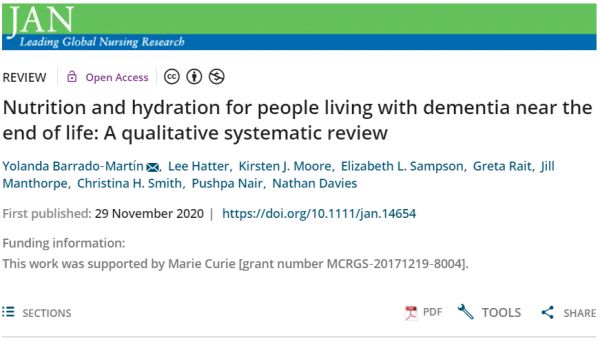

摘要
目的
综合定性证据,来汇总痴呆症患者、家庭护理人员和从业者对临终痴呆症患者的营养和水分补充的看法和体验。
设计
定性研究的系统综述和叙述性综合。
数据源
MEDLINE,Embase,PsycINFO,CINAHL。
审查方法
从数据库中搜索2000年1月至2020年2月的定性研究。不包括定量研究或报告生物学机制、评估、量表或诊断工具的研究。采用叙述性综合方法对结果进行主题分析。
结果
纳入20项研究。15项探索了从业者与长期护理机构或医院中痴呆症患者一起工作的观点。形成了四个主题:支持营养和水分的挑战;在“正确的事情”与各方意见之间取得平衡;国家背景和社会文化影响;以及在临终痴呆症患者支持营养和补水的策略。
结论
为临终痴呆症患者支持营养和补水的复杂性与国情、缺乏知识以及在人们交流时计划不足有关。

英文摘要
AimsTo synthesize the qualitative evidence of the views and experiences of people living with dementia, family carers, and practitioners on practice related to nutrition and hydration of people living with dementia who are nearing end of life.
Design
Systematic review and narrative synthesis of qualitative studies.
Data sources
MEDLINE, Embase, PsycINFO, CINAHL.
Review methods
Databases were searched for qualitative studies from January 2000‐February 2020. Quantitative studies, or studies reporting on biological mechanisms, assessments, scales or diagnostic tools were excluded. Results were synthesized using a narrative synthesis approach with thematic analysis.
Results
Twenty studies were included; 15 explored the views of practitioners working with people living with dementia in long‐term care settings or in hospitals. Four themes were developed: challenges of supporting nutrition and hydration; balancing the views of all parties involved with ‘the right thing to do’; national context and sociocultural influences; and strategies to support nutrition and hydration near the end of life in dementia.
Conclusion
The complexity of supporting nutrition and hydration near the end of life for someone living with dementia relates to national context, lack of knowledge, and limited planning while the person can communicate.
Impact
This review summarizes practitioners and families’ experiences and highlights the need to include people living with dementia in studies to help understand their views and preferences about nutrition and hydration near the end of life; and those of their families supporting them in the community. The review findings are relevant to multidisciplinary teams who can learn from strategies to help with nutrition and hydration decisions and support.
原文链接:
https://onlinelibrary.wiley.com/doi/full/10.1111/jan.14654
本文由“健康号”用户上传、授权发布,以上内容(含文字、图片、视频)不代表健康界立场。“健康号”系信息发布平台,仅提供信息存储服务,如有转载、侵权等任何问题,请联系健康界(jkh@hmkx.cn)处理。
相关知识
预防失智与老年痴呆 补充DHA有用吗?临床研究这么说
护理SCI晨读:孕妇压力管理的身心干预:随机对照试验的系统评价和荟萃分析
超30万人研究发现:握力越大,患痴呆症风险越低 —— 握力成认知健康新指标
饮咖啡可抗痴呆
老年痴呆症有哪些养护方法
【老年痴呆筛查量表】多发性腔梗和老年性脑萎缩=老年痴呆?
科普小知识:阿尔茨海默氏症=老年痴呆?关于痴呆症的11个误解
多运动有助预防老年痴呆症
口服营养补充指南
什么是认知健康?中国痴呆照护未来在哪里?
网址: 护理SCI晨读:临终痴呆症患者的营养和水分补充:定性研究系统评价 https://www.trfsz.com/newsview886342.html
推荐资讯




- 1发朋友圈对老公彻底失望的心情 12775
- 2BMI体重指数计算公式是什么 11235
- 3补肾吃什么 补肾最佳食物推荐 11199
- 4性生活姿势有哪些 盘点夫妻性 10428
- 5BMI正常值范围一般是多少? 10137
- 6在线基础代谢率(BMR)计算 9652
- 7一边做饭一边躁狂怎么办 9138
- 8从出汗看健康 出汗透露你的健 9063
- 9早上怎么喝水最健康? 8613
- 10五大原因危害女性健康 如何保 7828