
Association of B vitamins with chronic constipation and diarrhea: a cross
[摘要] 目的 探讨B族维生素(维生素B1、B2、B6,烟酸)的摄入量与慢性便秘、慢性腹泻的关系。方法 合并美国国家健康和营养调查数据库(National Health and Nutrition Examination Survey,NHANES)3个周期(2005-2006年、2007-2008年和2009-2010年)的数据信息进行分析,共纳入13 788名参与者,通过24 h饮食回忆访谈评估维生素B1、B2、B6,烟酸的摄入量。采用多元Logistic回归分析探讨B族维生素与慢性便秘、慢性腹泻的相关性,并进行了分层分析和曲线拟合相关分析。结果 纳入的受试者中有2 520人(18.28%)存在慢性便秘,2 138人(15.51%)存在慢性腹泻。多元Logistic回归和分层分析结果显示,维生素B1、烟酸、维生素B6的摄入量与慢性便秘、慢性腹泻呈线性相关(P<0.05),每日摄入量的增加可降低慢性便秘的发生风险,但会增加慢性腹泻的发生风险(P<0.05)。结论 维生素B1、B2、B6,烟酸与慢性便秘、慢性腹泻存在相关性。
Association of B vitamins with chronic constipation and diarrhea: a cross-sectional study based on data from NHANES
[Abstract] Objective To investigate the relationship between daily intake of B vitamins (vitamins B1, B2, B6 and niacin) and chronic constipation and chronic diarrhea. Methods Data of 3 durations (2005-2006, 2007-2008 and 2009-2010) from National Health and Nutrition Examination Survey (NHANES) database were collected and retrospectively analyzed. For the 13 788 participants, their intake of vitamin B1, B2, B6, and niacin were assessed through a 24-hour dietary recall interview. Multivariate logistic regression analysis was employed to explore the correlation between B vitamins and chronic constipation and chronic diarrhea. Additionally, sensitivity analysis and curve fitting correlation analysis were conducted to further elucidate the observed relationships. Results Among the subjects who were enrolled in the study, 2 520 (18.28%) were diagnosed with chronic constipation, while 2 138 (15.51%) were diagnosed with chronic diarrhea. Multivariate logistic regression analysis and sensitivity analysis indicated linear correlations between the intake of vitamin B1, niacin and vitamin B6 and the occurrence of chronic constipation and chronic diarrhea. An increase in the daily intake of these nutrients potentially reduced the risk of chronic constipation, but also increased the risk of chronic diarrhea (P < 0.05). Conclusion Daily intake of vitamins B1, B2, B6 and niacin is correlated with the occurrence of chronic constipation and chronic diarrhea.
慢性便秘通常表现为排便次数减少(每周<3次)、粪便干硬或排便困难。排便困难主要指排便费力、排便不尽感、肛门坠胀感等[1]。便秘影响着全球15%~20%人口的生活质量[2],在美国门诊就诊的患者中,慢性便秘位居胃肠道疾病诊断量的前5位[3],并带来重大的医疗保健负担。慢性腹泻通常指稀便、大便频率增加或排便急迫感等症状,且持续时间>4周。据估计,1%~5%的成年人存在慢性腹泻[4]。既往研究表明,慢性便秘、慢性腹泻与饮食摄入存在相关性,例如,可发酵低聚双单糖和多元醇饮食可改善腹泻型肠易激综合征患者的腹泻症状[5-6];每日碳水化合物摄入量与慢性腹泻之间存在正相关关系[7];膳食纤维摄入量可改善慢性便秘的症状[2]。
B族维生素是人体生理代谢和调节过程所必需的微量营养素,是体内数百种酶所使用的辅助因子,但人体自身无法合成大多数B族维生素,需依赖饮食摄入的补充[8]。既往关于膳食中B族维生素摄入量对慢性便秘、慢性腹泻影响的研究有限,本研究旨在通过美国国家健康和营养调查(National Health and Nutrition Examination Survey,NHANES)数据库的数据信息评估每日膳食中B族维生素(维生素B1、B2、B6,烟酸)摄入量,探讨其与慢性便秘和慢性腹泻的关系。
1 资料与方法 1.1 研究设计与研究对象
NHANES数据库是一个以人口学为基础的美国全国性横断面调查数据库,由美国疾病控制和预防中心的国家卫生统计中心每年进行1次数据采集,每2年进行1次数据发布。根据分层多阶段整群抽样设计随机筛选参与者,通过访谈进行信息收集。本研究合并NHANES数据库3个周期(2005-2006年、2007-2008年和2009-2010年) 的数据信息进行分析,共纳入13 788人,具体流程见图 1。NHANES数据库的项目研究伦理审查委员会批准了本研究方案,参与者在注册时提供了书面知情同意书(http://www.cdc.gov/nchs/nhanes/irba98.htm)。由于本研究采纳的是基于公开的去标识化数据,因此不再需要伦理批准和同意。
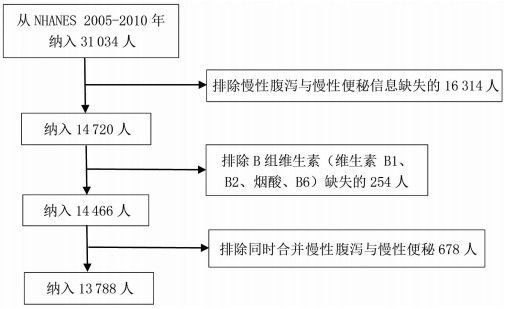 图 1研究参与者纳入流程图
 1.2 B族维生素(维生素B1、B2、B6,烟酸)的摄入量
NHANES数据库中膳食B族维生素的数据采用24 h饮食回忆访谈进行评估。共进行2次访谈,第1次访谈在美国疾病控制和预防中心设立的移动检测中心进行,并现场数据收集;第2次访谈在距第1次访谈的3~10 d后通过电话进行,并数据采集。基于生物标志物的研究证据表明,与食物频率问卷比较,24 h饮食回忆访谈对饮食摄入量的偏差更小。考虑到现场采集的数据更加准确,该研究涉及的B族维生素(维生素B1、B2、B6,烟酸)摄入量数据采用第1次访谈所采集的数据。
1.3 慢性便秘、慢性腹泻参与者的筛选
NHANES数据库的肠道健康问卷用于识别患有慢性便秘和慢性腹泻的参与者。研究人员向参与者展示一张有彩色图片和对粪便类型描述的卡片,并要求参与者回答在过去12个月里最常见的大便类型。同时,研究者会询问参与者“每周大便次数”“过去12个月是否有便秘”“过去12个月是否有腹泻”“过去30天内每周服用泻药”等问题,以识别出慢性便秘和慢性腹泻者。
本研究中慢性便秘的参与者包括:①大便类型划分为1型(单独的硬块)或2型(块状香肠状)者;②每周排便<3次者;③过去12个月经常便秘者;④在过去30 d内每周服用≥1次泻药者。慢性腹泻的参与者包括:①大便类型为6型(软边大便伴浆糊样大便)或7型(水状,无固体团块)者;②每周大便>21次者;③过去12个月经常腹泻者。
1.4 协变量
研究考虑了潜在的协变量。协变量包括参与者在家庭访谈中自我报告的年龄、性别、教育程度、婚姻状况、收入比和体质指数(body mass index, BMI)。种族划分为非西班牙裔白人、非西班牙裔黑人、墨西哥裔美国人和其他种族。吸烟者指每年吸烟量≥100支烟的参与者。饮酒者指每年饮酒量≥2.66 L的参与者。
1.5 统计学分析
符合正态分布的计量资料以x±s表示,采用两组独立样本t检验;符合偏态分布的计量资料以M(P25,P75) 表示,采用两组独立样本的秩和检验。P<0.05表示差异具有统计学意义。B族维生素(维生素B1、B2、B6,烟酸)摄入量为连续变量,采用Logistic回归模型分别研究B族维生素(维生素B1、B2、B6,烟酸)摄入量与慢性便秘、慢性腹泻之间的关联。协变量缺失值采用多重插补方式进行。通过模型1调整了性别、年龄、体质指数,模型2调整了性别、年龄、种族、体质指数、受教育程度、婚姻状况。并按性别、年龄、体质指数进行了分层分析,以确定B族维生素(维生素B1、B2、B6,烟酸)与慢性便秘、慢性腹泻的关联的稳定性。同时将慢性便秘、慢性腹泻与维生素B1、B2、B6,烟酸做了曲线拟合,必要的进行了拐点分析。比值比(OR) 和95%CI通过Logistic回归模型计算。统计分析使用R语言(http://www.R-project.org) 和风锐软件1.9.2。
2 结果 2.1 参与者的基线特征
纳入的参与者共有13 788人,其中2 520人(18.28%)存在慢性便秘,2 138人(15.51%)存在慢性腹泻,其基线特征见表 1。慢性便秘者女性多于男性,而慢性腹泻者男性多于女性。慢性便秘与慢性腹泻年龄均集中在20~60岁,超重和肥胖人群中较多,教育水平在高中以上居多,饮酒者较多,收入比均集中在中等(>1.31~3.5)水平(P均<0.01)。慢性便秘者维生素B1、B2、B6,烟酸的摄入量均低于非慢性便秘者(P<0.01);慢性腹泻者的维生素B1、B6,烟酸的摄入量均高于非慢性腹泻者(P<0.01),而维生素B2的摄入量在慢性腹泻与非慢性腹泻者中差异无统计学意义,见表 2。
表 1 参与者的人口学描述[例(%)]
变量 总数(n=13 788) 慢性便秘(n=2 520) 慢性腹泻(n=2 138) F P 性别 296.52 <0.01 男 6 839(49.6) 860(34.1) 1 112(52.0) 女 6 949(50.4) 1 660(65.9) 1 026(48.0) 年龄/岁 19.31 <0.01 <20 243(1.8) 69(2.7) 25(1.2) 20~60 9 245(67.1) 1679(66.6) 1 448(67.7) >60 4 300(31.2) 772(30.7) 665(31.1) BMI(kg/m2) 106.35 <0.01 <18.5 208(1.5) 50(1.9) 33(1.5) 18.5~24.9 3 846(27.9) 811(32.2) 451(21.1) ≥25.0~29.9 4 714(34.2) 816(32.4) 709(33.2) >30.0 5 020(36.4) 843(33.5) 945(44.2) 种族 74.93 <0.01 墨西哥裔美国人 2 516(18.2) 427(16.9) 457(21.4) 非西班牙裔白人 6 847(49.7) 1 159(46.0) 982(45.9) 非西班牙裔黑人 2 738(19.9) 610(24.2) 409(19.1) 其他种族 1 687(12.3) 324(12.9) 290(13.6) 教育 43.22 <0.01 低于高中 3 833(27.8) 765(30.4) 692(32.4) 高中及以上 9 945(72.2) 1 755(69.6) 1 446(67.6) 婚姻 4.66 0.09 未婚 3 328(24.1) 650(25.8) 502(23.5) 已婚 10 452(75.8) 1 870(74.2) 1 634(76.4) 未知 8(0.1) 2(0.1) 收入比 102.91 <0.01 ≤1.30 3 719(27.0) 779(30.9) 660(30.8) >1.30~3.5 4 907(35.6) 938(37.2) 722(33.8) >3.5 4 166(30.2) 608(24.1) 569(26.6) 未知 996(7.2) 195(7.7) 180(8.8) 饮酒 81.57 <0.01 否 3 933(28.5) 902(35.8) 596(27.9) 是 9 846(71.4) 1 615(64.2) 1 540(72.0) 未知 9(0.1) 3(0.1) 2(0.1) 吸烟 1.03 0.59 否 3 518(25.5) 579(23.0) 589(27.5) 是 3 007(21.8) 522(20.7) 506(23.7) 未知 7 263(52.7) 1 419(56.3) 1 043(48.8)表 2 B族维生素的摄入量在慢性便秘、非慢性便秘和慢性腹泻、非慢性腹泻患者中的差异(x±s)
指标 慢性便秘(n=2 520) 非慢性便秘(n=11 268) t P 慢性腹泻(n=2 138) 非慢性腹泻(n=11 650) t P 维生素B1/mg 1.5±0.9 1.6±1.0 51.05 <0.01 1.7±1.0 1.6±1.0 26.67 <0.01 维生素B2/mg 1.9±1.2 2.2±1.3 63.79 <0.01 2.2±1.3 2.1±1.3 31.90 0.09 烟酸/mg 22.2±13.7 25.2±14.9 85.31 <0.01 25.8±15.5 24.4±14.6 45.17 <0.01 维生素B6/mg 1.8±1.3 2.0±1.4 56.34 <0.01 2.1±1.4 2.0±1.4 30.26 <0.012.2 慢性便秘、慢性腹泻的单因素和多元Logistic回归分析
单因素结果分析提示,慢性便秘、慢性腹泻均与年龄、性别、种族、BMI、教育水平、收入比差异具有统计学意义(P<0.05),同时慢性便秘与维生素B1、维生素B2、烟酸、维生素B6摄入量差异具有统计学意义,而慢性腹泻与维生素B1、烟酸、维生素B6摄入量差异具有统计学意义(P<0.05,表 3)。
表 3 慢性便秘、慢性腹泻单因素Logistic回归分析
变量 慢性便秘 慢性腹泻 OR(95%CI) P OR(95%CI) P 女性 2.18(1.99, 2.38) <0.01 0.89(0.81, 0.98) 0.02 年龄/岁 20~60 0.56(0.42, 0.74) <0.01 1.62(1.07, 2.46) 0.02 >60 0.55(0.41, 0.73) <0.01 1.60(1.05, 2.43) 0.03 BMI(kg/m2) <18.5 1.18(0.85, 1.64) 0.31 1.42(0.97, 2.09) 0.07 ≥25.0~29.9 0.78(0.70, 0.87) <0.01 1.33(1.17, 1.51) <0.01 >30.0 0.76(0.67, 0.84) <0.01 1.75(1.55, 1.97) <0.01 种族 非西班牙裔白人 0.99(0.88, 1.12) 0.96 0.75(0.67, 0.85) <0.01 非西班牙裔黑人 1.40(1.22, 1.60) <0.01 0.79(0.68, 0.92) <0.01 其他种族 0.92(0.71, 1.18) 0.53 0.98(0.77, 1.25) 0.88 高中以上 0.86(0.78, 0.94) <0.01 0.77(0.70, 0.85) <0.01 已婚 0.89(0.81, 0.99) 0.03 1.04(0.94, 1.16) 0.45 收入比 >1.30~3.5 0.89(0.80, 0.99) 0.04 0.80(0.71, 0.90) <0.01 >3.5 0.64(0.57, 0.72) <0.01 0.73(0.65, 0.83) <0.01 饮酒 0.65(0.60, 0.72) <0.01 1.04(0.94, 1.15) 0.48 吸烟 1.06(0.93, 1.21) 0.33 1.01(0.88, 1.15) 0.93 维生素B1/mg 0.82(0.78, 0.86) <0.01 1.07(1.02, 1.12) <0.01 维生素B2/mg 0.84(0.81, 0.88) <0.01 1.03(1.00, 1.07) 0.09 烟酸/mg 0.98(0.98, 0.98) <0.01 1.01(1.00, 1.01) <0.01 维生素B6/mg 0.86(0.82, 0.89) <0.01 1.06(1.02, 1.09) <0.01多元Logistic回归模型分析慢性便秘、慢性腹泻与维生素B1、维生素B2、烟酸、维生素B6摄入量的关系,结果显示,慢性便秘与维生素B1、维生素B2、烟酸、维生素B6摄入量均显著负相关(P<0.05),而慢性腹泻与维生素B1、烟酸、维生素B6摄入量显著正相关(P<0.05),见表 4、5。
表 4 慢性便秘、慢性腹泻多元Logistic回归分析(模型1)
指标 慢性便秘 慢性腹泻 OR(95%CI) P OR(95%CI) P 维生素B1/mg 0.91(0.86~0.96) <0.001 1.07(1.02~1.12) 0.007 维生素B2/mg 0.91(0.87~0.94) <0.001 1.03(0.99~1.06) 0.135 烟酸/mg 0.99(0.98~0.99) <0.001 1.01(1.00~1.01) <0.001 维生素B6/mg 0.92(0.89~0.96) <0.001 1.06(1.02~1.09) <0.001表 5 慢性便秘、慢性腹泻多元Logistic回归分析(模型2)
指标 慢性便秘 慢性腹泻 OR(95%CI) P OR(95%CI) P 维生素B1/mg 0.93(0.88~0.98) 0.007 1.07(1.03~1.13) 0.003 维生素B2/mg 0.93(0.89~0.97) <0.001 1.04(1.00~1.07) 0.039 烟酸/mg 0.99(0.98~0.99) <0.001 1.01(1.00~1.01) <0.001 维生素B6/mg 0.93(0.89~0.97) <0.001 1.06(1.03~1.09) <0.0012.3 维生素B1、B2、烟酸、维生素B6摄入量与慢性便秘、慢性腹泻的分层分析
对年龄、性别、体质指数的分层分析结果显示,维生素B1、B2、烟酸、维生素B6摄入量与慢性便秘的显著相关性及维生素B1、烟酸、维生素B6摄入量与慢性腹泻的显著相关性,在年龄、性别、体质指数分组中不存在交互作用,结果稳定(表 6、7)。
表 6 维生素B1、B2、烟酸、维生素B6摄入量与慢性便秘的分层分析
指标 维生素B1/mg 维生素B2/mg 烟酸/mg 维生素B6/mg OR(95%CI) P 交互P OR(95%CI) P 交互P OR(95%CI) P 交互POR(95%CI) P 交互P BMI/(kg/m2) <18.5 0.81(0.50, 1.20) 0.29 0.86(0.64, 1.16) 0.32 0.98(0.96, 1.01) 0.22 0.81(0.60, 1.11) 0.19 18.5~24.9 0.77(0.70, 0.85) <0.01 0.21 0.80(0.74, 0.86) <0.01 0.13 0.98(0.97, 0.98) <0.01 0.09 0.80(0.75, 0.86) <0.01 0.07 ≥25.0~29.9 0.84(0.70, 0.92) <0.01 0.88(0.82, 0.94) <0.01 0.98(0.98, 0.99) <0.01 0.88(0.82, 0.94) <0.01 >30.0 0.91(0.80, 0.99) 0.03 0.91(0.85, 0.98) 0.01 0.99(0.98, 1.00) <0.01 0.92(0.86, 0.98) 0.01 性别 男性 0.96(0.80, 1.03) 0.22 0.56 0.97(0.92, 1.02) 0.26 0.070 0.99(0.99, 1.00) 0.01 0.598 0.95(0.90, 1.00) 0.06 0.66 女性 0.91(0.80, 0.99) 0.02 0.89(0.84, 0.95) <0.01 0.99(0.99, 1.00) <0.01 0.93(0.88, 0.98) <0.01 年龄/岁 <20 0.73(0.50, 1.00) 0.05 0.63 0.73(0.56, 0.96) 0.02 0.169 0.98(0.96, 1.00) 0.05 0.867 0.74(0.57, 0.97) 0.03 0.36 20~60 0.84(0.70, 0.89) <0.01 0.86(0.82, 0.90) <0.01 0.98(0.98, 0.99) <0.01 0.86(0.82, 0.90) <0.01 >60 0.84(0.70, 0.94) <0.01 0.90(0.82, 0.97) 0.01 0.98(0.97, 0.99) <0.01 0.89(0.82, 0.97) <0.01表 7 维生素B1、烟酸、维生素B6摄入量与慢性腹泻的分层分析
指标 维生素B1/mg 烟酸/mg 维生素B6/mg OR(95%CI) P 交互P OR(95%CI) P 交互POR(95%CI) P 交互P BMI/(kg/m2) <18.5 1.08(1.00, 1.17) 0.05 0.25 1.01(1.00, 1.01) <0.01 0.16 1.08(1.02, 1.14) <0.01 0.286 18.5~24.9 0.71(0.42, 1.21) 0.21 0.97(0.94, 1.01) 0.13 0.77(0.52, 1.15) 0.21 ≥25.0~29.9 1.11(1.02, 1.21) 0.01 1.01(1.00, 1.01) <0.01 1.09(1.03, 1.15) <0.01 >30.0 1.08(1.01, 1.17) 0.04 1.01(1.00, 1.01) 0.03 1.05(1.00, 1.11) 0.05 性别 男性 1.07(1.01, 1.13) 0.02 0.91 1.01(1.00, 1.01) <0.01 0.12 1.07(1.03, 1.11) <0.01 0.09 女性 1.07(0.98, 1.17) 0.12 1.00(1.00, 1.01) 0.49 1.01(0.95, 1.08) 0.74 年龄/岁 <20 1.14(0.83, 1.58) 0.42 0.81 1.02(0.99, 1.04) 0.18 0.58 1.15(0.88, 1.49) 0.29 0.33 20~60 1.09(1.03, 1.14) <0.01 1.01(1.00, 1.01) <0.01 1.07(1.04, 1.11) <0.01 >60 1.05(0.95, 1.17) 0.33 1.00(1.00, 1.01) 0.20 1.01(0.93, 1.09) 0.822.4 维生素B1、B2、B6,烟酸摄入量与慢性便秘、慢性腹泻的曲线拟合
曲线拟合结果显示,维生素B2摄入量与慢性便秘为曲线关系(P=0.013), 其余均为线性关系(图 2、3)。针对维生素B2摄入量与慢性便秘进行了拐点分析,结果显示,每日维生素B2摄入量以1.914 mg为拐点,在<1.914 mg随着维生素B2摄入量的增加,慢性便秘发生风险降低,差异存在统计学意义(P<0.01),而当每日摄入量超过1.914 mg后,两者差异无统计学意义(表 8)。
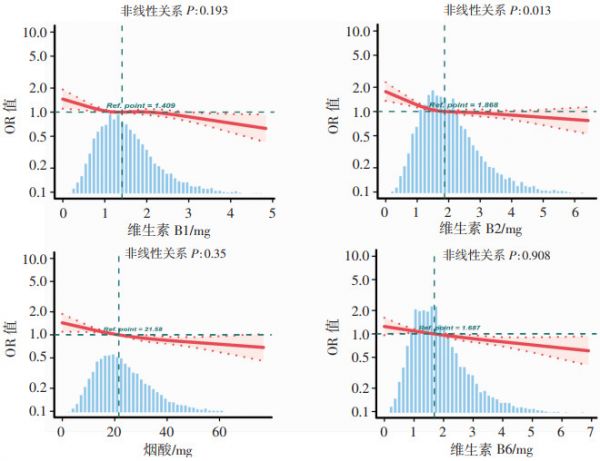 图 2慢性便秘与维生素B1、B2、烟酸、维生素B6摄入量的曲线拟合图
 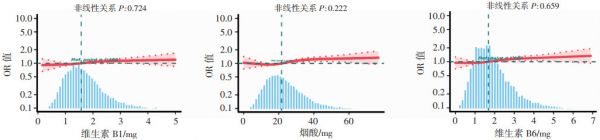 图 3慢性腹泻与维生素B1、烟酸、维生素B6摄入量的曲线拟合图
 表 8 维生素B2摄入量与慢性便秘拐点分析
指标 OR(95%CI) P 维生素B2摄入量≤1.914 mg 0.750(0.649~0.867) <0.01 维生素B2摄入量>1.914 mg 0.960(0.883~1.037) 0.283 讨论
本研究为结合NHANES数据库中大样本进行关于B族维生素(维生素B1、B2、B6,烟酸)每日摄入量与慢性便秘、慢性腹泻相关性的研究。研究发现,维生素B1、烟酸、B6的摄入量与慢性便秘和慢性腹泻均相关,维生素B2的摄入量与慢性便秘呈非线性关系,与慢性腹泻无相关性。
3.1 B族维生素可能通过肠道菌群调节慢性便秘和腹泻
越来越多的证据表明,便秘患者的胃肠道微生物群组成与正常个体明显不同,便秘患者肠道菌群的物种多样性低于健康者,与健康者比较,便秘患者肠道内的双歧杆菌和乳杆菌丰度显著降低,而脱硫弧菌科的丰度升高[9]。且在一项关于慢性便秘患者的机器学习模型研究中,发现15种与便秘相关的菌群,其中包括与炎症相关的致病菌属Serratia, Dorea和Aeromonas[10]。同样,慢性腹泻与肠道菌群的研究表明,个体肠道微生物群多样性与组成的变化可能是慢性腹泻发生的原因[11],且益生菌具有缓解慢性腹泻患者临床症状的潜力[12-13]。而在既往研究中发现,B族维生素与肠道菌群也存在着复杂的关系,如膳食维生素B1对共生肠道菌群中细菌的生存和竞争具有显著影响,充足的膳食维生素B1摄入量会影响瘤胃球菌科的相对丰度[14],且肠道沙门氏菌和大肠杆菌等微生物能够合成维生素B1[15], 完全依赖维生素B1转运的肠道微生物,如Alistipes属的成员,在维生素B1摄入量下降时,菌群的丰度会受到影响[16]。维生素B2可通过改变克罗恩患者的肠道菌群组成来改善临床症状[17]。烟酸是多种酶的辅助因子, 其相关补充剂可以通过调节肠道微生物群的组成,对肠道通透性[18]和炎症产生有益影响[19-21]。相似的,当维生素B6缺乏时,拟杆菌科的微生物群相对丰度显著减少,而毛螺菌科的相对丰度增加[22]。结合本研究结果,考虑维生素B(维生素B1、B2、B6,烟酸)摄入量对慢性腹泻、慢性便秘的影响可能与患者肠道菌群的多样性与组成相关,需进一步的前瞻性研究进行验证。
3.2 B族维生素可能通过心理健康状态间接影响慢性腹泻与便秘
此外,有研究表明,在抑郁症患者中慢性便秘、慢性腹泻的发生率较高[23]。截至2023年,抑郁症影响着全球约2.8亿人的生活质量[24],健康的饮食习惯和个体饮食成分可以改善人体的心理健康[25-30]。目前可用于治疗常见精神疾病的药物包括维生素和矿物质,许多研究表明这些药物比传统抗抑郁药更有效[25]。而在关于维生素与抑郁症的研究中发现,维生素B1、B2、B6,烟酸的摄入可以预防抑郁症的发生[31-33],考虑可能与它们对同型半胱氨酸代谢和单胺类神经递质(如多巴胺、去甲肾上腺素和血清素)合成有关[34]。维生素B1的缺乏对神经系统有不利影响,与神经炎症、T细胞浸润、促炎细胞因子(白介素-1、肿瘤坏死因子-1、白介素-6)和花生四烯酸产物的过度表达有关,同时还会刺激小胶质细胞和星形胶质细胞表达CD40和CD40L,引发神经元的死亡[35]。维生素B2的缺乏可导致抑郁症,考虑与黏膜相关恒定T细胞(mucosal-associated invariant T cells, MAITs)的功能密切相关,MAITs是唯一被组织相容性复合物相关蛋白1结合的核黄素代谢物衍生物激活的T1细胞[36-37]。此外在白介素-1、白介素-6和肿瘤坏死因子-α水平升高的情况下,烟酸能够降低巨噬细胞产生促炎细胞因子[38]。根据既往维生素B与抑郁症的相关研究,同时结合本研究结果,考虑慢性便秘、慢性腹泻与B族维生素(维生素B1、B2、B6,烟酸)的关系可能与维生素的摄入与抑郁症的相关性有关,未来可设计相关队列进行验证。
本研究的优势在于数据来源于公共数据库,样本量较大,使研究结果更可靠,更具推广性;其次,同时研究了B族维生素(维生素B1、B2、B6,烟酸)与慢性便秘、慢性腹泻的关系,通过2个反向结局进一步表明B族维生素与肠道健康的关系;最后,该研究表明了B族维生素每日摄入量与慢性便秘、慢性腹泻的关系,为通过调整B族维生素(维生素B1、B2、B6,烟酸)的摄入量改善消化道症状提供了依据,也为慢性便秘、慢性腹泻发生的可能机制提供了新的思路。但本研究也存在一定的局限性:①NHANES数据库是一个横断面研究,无法确定因果推论;②不能排除所有相关慢性疾病或其他无法测量的混杂因素的潜在影响;③该数据库为公共营养的数据库,疾病数据较少,数据库中关于慢性腹泻与便秘的数据涉及的年份仅有2005-2010年,且暂未更新。
综上所述,B族维生素(维生素B1、B2、B6,烟酸)与慢性便秘、慢性腹泻存在相关性,通过调整维生素B1、B2、B6,烟酸的每日摄入量可能改善慢性便秘和慢性腹泻的症状,但其因果关系和机制还需进行进一步研究。
参考文献
[1] 中华医学会外科学分会结直肠外科学组. 中国成人慢性便秘评估与外科处理临床实践指南(2022版)[J]. 中华胃肠外科杂志, 2022, 25(1): 1-9.
Rectal Surgery Group of Surgery Branch of Chinese Medical Association. Clinical practice guideline on the evaluation and management of chronic constipation for Chinese adults(2022 edition)[J]. Chin J Gastrointest Surg, 2022, 25(1): 1-9.
SHARMA A, RAO S S C, KEARNS K, et al. Review article: diagnosis, management and patient perspectives of the spectrum of constipation disorders[J]. Aliment Pharmacol Ther, 2021, 53(12): 1250-1267.
[3]SHAHEEN N J, HANSEN R A, MORGAN D R, et al. The burden of gastrointestinal and liver diseases, 2006[J]. Am J Gastroenterol, 2006, 101(9): 2128-2138.
[4]SCHILLER L R, PARDI D S, SELLIN J H. Chronic diarrhea: diagnosis and management[J]. Clin Gastroenterol Hepatol, 2017, 15(2): 182-193. e3.
[5]SHANKAR S, DURAIRAJ E. Diet and management of diarrhea[J]. Indian J Pediatr, 2024, 91(6): 590-597.
[6]BERTIN L, ZANCONATO M, CREPALDI M, et al. The role of the FODMAP diet in IBS[J]. Nutrients, 2024, 16(3): 370.
[7]SINGH P, MITSUHASHI S, BALLOU S, et al. Demographic and dietary associations of chronic diarrhea in a representative sample of adults in the United States[J]. Am J Gastroenterol, 2018, 113(4): 593-600.
[8]PETERSON C T, RODIONOV D A, OSTERMAN A L, et al. B vitamins and their role in immune regulation and cancer[J]. Nutrients, 2020, 12(11): 3380.
[9]ZHUANG M, SHANG W T, MA Q C, et al. Abundance of probiotics and butyrate-production microbiome manages constipation via short-chain fatty acids production and hormones secretion[J]. Mol Nutr Food Res, 2019, 63(23): e1801187.
[10]CHEN Y T, WU T, LU W W, et al. Predicting the role of the human gut microbiome in constipation using machine-learning methods: a meta-analysis[J]. Microorganisms, 2021, 9(10): 2149.
[11]RINGEL Y. The gut microbiome in irritable bowel syndrome and other functional bowel disorders[J]. Gastroenterol Clin North Am, 2017, 46(1): 91-101.
[12]MARTONI C J, SRIVASTAVA S, LEYER G J. Lactobacillus acidophilus DDS-1 and Bifidobacterium lactis UABla-12 improve abdominal pain severity and symptomology in irritable bowel syndrome: randomized controlled trial[J]. Nutrients, 2020, 12(2): E363.
[13]ISHAQUE S M, KHOSRUZZAMAN S M, AHMED D S, et al. A randomized placebo-controlled clinical trial of a multi-strain probiotic formulation(Bio-Kult®) in the management of diarrhea-predominant irritable bowel syndrome[J]. BMC Gastroenterol, 2018, 18(1): 71.
[14]PARK J, HOSOMI K, KAWASHIMA H, et al. Dietary vitamin B1 intake influences gut microbial community and the consequent production of short-chain fatty acids[J]. Nutrients, 2022, 14(10): 2078.
[15]BOZIC I, LAVRNJA I. Thiamine and benfotiamine: Focus on their therapeutic potential[J]. Heliyon, 2023, 9(11): e21839.
[16]COSTLIOW Z A, DEGNAN P H. Thiamine acquisition strategies impact metabolism and competition in the gut microbe Bacteroides thetaiotaomicron[J]. mSystems, 2017, 2(5): e00116-e00117.
[17]VON MARTELS J Z H, BOURGONJE A R, KLAASSEN M A Y, et al. Riboflavin supplementation in patients with Crohn's disease[the RISE-UP study[J]. J Crohns Colitis, 2020, 14(5): 595-607.
[18]HUANG P, JIANG A Q, WANG X X, et al. NMN maintains intestinal homeostasis by regulating the gut microbiota[J]. Front Nutr, 2021, 8: 714604.
[19]HUANG P, WANG X X, WANG S Y, et al. Treatment of inflammatory bowel disease: Potential effect of NMN on intestinal barrier and gut microbiota[J]. Curr Res Food Sci, 2022, 5: 1403-1411.
[20]KANG K, SUN Y, PAN D, et al. Nicotinamide ameliorates dextran sulfate sodium-induced chronic colitis in mice through its anti-inflammatory properties and modulates the gut microbiota[J]. J Immunol Res, 2021, 2021: 5084713.
[21]PELUSO A A, LUNDGAARD A T, BABAEI P, et al. Oral supplementation of nicotinamide riboside alters intestinal microbial composition in rats and mice, but not humans[J]. NPJ Aging, 2023, 9(1): 7.
[22]MAYENGBAM S, CHLEILAT F, REIMER R A. Dietary vitamin B6 deficiency impairs gut microbiota and host and microbial metabolites in rats[J]. Biomedicines, 2020, 8(11): 469.
[23]BALLOU S, KATON J, SINGH P, et al. Chronic diarrhea and constipation are more common in depressed individuals[J]. Clin Gastroenterol Hepatol, 2019, 17(13): 2696-2703.
[24]RUBIN. Profile: institute for health metrics and evaluation, WA, USA[J]. Lancet, 2017, 389(10068): 493.
[25]BREMNER J D, MOAZZAMI K, WITTBRODT M T, et al. Diet, stress and mental health[J]. Nutrients, 2020, 12(8): 2428.
[26]BOTTURI A, CIAPPOLINO V, DELVECCHIO G, et al. The role and the effect of magnesium in mental disorders: a systematic review[J]. Nutrients, 2020, 12(6): 1661.
[27]TARLETON E K, LITTENBERG B, MACLEAN C D, et al. Role of magnesium supplementation in the treatment of depression: a randomized clinical trial[J]. PLoS One, 2017, 12(6): e0180067.
[28]TARLETON E K, LITTENBERG B. Magnesium intake and depression in adults[J]. J Am Board Fam Med, 2015, 28(2): 249-256.
[29]FIELD D T, CRACKNELL R O, EASTWOOD J R, et al. High-dose Vitamin B6 supplementation reduces anxiety and strengthens visual surround suppression[J]. Hum Psychopharmacol, 2022, 37(6): e2852.
[30]MENON V, KAR S K, SUTHAR N, et al. Vitamin D and depression: a critical appraisal of the evidence and future directions[J]. Indian J Psychol Med, 2020, 42(1): 11-21.
[31]MROWICKA M, MROWICKI J, DRAGAN G, et al. The importance of thiamine(vitamin B1) in humans[J]. Biosci Rep, 2023, 43(10): BSR20230374.
[32]WU Y J, ZHANG L M, LI S Y, et al. Associations of dietary vitamin B1, vitamin B2, vitamin B6, and vitamin B12 with the risk of depression: a systematic review and meta-analysis[J]. Nutr Rev, 2022, 80(3): 351-366.
[33]BAJ J, BARGIEŁ J, CABAJ J, et al. Trace elements levels in major depressive disorder-evaluation of potential threats and possible therapeutic approaches[J]. Int J Mol Sci, 2023, 24(20): 15071.
[34]ARÉVALO S P, SCOTT T M, FALCÓN L M, et al. Vitamin B-6 and depressive symptomatology, over time, in older Latino adults[J]. Nutr Neurosci, 2019, 22(9): 625-636.
[35]SCALABRINO G. Vitamin-regulated cytokines and growth factors in the CNS and elsewhere[J]. J Neurochem, 2009, 111(6): 1309-1326.
[36]JI Z, FAN Z Q, ZHANG Y, et al. Thiamine deficiency promotes T cell infiltration in experimental autoimmune encephalomyelitis: the involvement of CCL2[J]. J Immunol, 2014, 193(5): 2157-2167.
[37]KJER-NIELSEN L, PATEL O, CORBETT A J, et al. MR1 presents microbial vitamin B metabolites to MAIT cells[J]. Nature, 2012, 491(7426): 717-723.
[38]LIPSZYC P S, CREMASCHI G A, ZORRILLA-ZUBILETE M, et al. Niacin modulates pro-inflammatory cytokine secretion. a potential mechanism involved in its Anti-atherosclerotic effect[J]. Open Cardiovasc Med J, 2013, 7: 90-98.
相关知识
The association between physical fitness and mental health among college students: a cross
Dietary, physical exercises and mental stress in a Chinese population: a cross
Health coaching interventions for persons with chronic conditions: a systematic review and meta
The Relationship Between the Number of Chronic Diseases and Health
Fiber supplements and clinically proven health benefits: How to recognize and recommend an effective fiber therapy
Research progress and potential mechanism of postbiotics in alleviating gastrointestinal diseases
Association between the Healthy Lifestyle Index and risk of multimorbidity in the Women’s Health Initiative,The Journals of Gerontology Series A: Biological Sciences and Medical Sciences
Operationalizing Surveillance of Chronic Disease Self
Association Between Nutrition, Diet Quality, Dietary Patterns, and Human Health and Diseases
Oral Health Education in Patients with Diabetes: A Systematic Review
网址: Association of B vitamins with chronic constipation and diarrhea: a cross https://www.trfsz.com/newsview1770141.html
推荐资讯




- 1发朋友圈对老公彻底失望的心情 12775
- 2BMI体重指数计算公式是什么 11235
- 3补肾吃什么 补肾最佳食物推荐 11199
- 4性生活姿势有哪些 盘点夫妻性 10428
- 5BMI正常值范围一般是多少? 10137
- 6在线基础代谢率(BMR)计算 9652
- 7一边做饭一边躁狂怎么办 9138
- 8从出汗看健康 出汗透露你的健 9063
- 9早上怎么喝水最健康? 8613
- 10五大原因危害女性健康 如何保 7828