
微纤维无处不在,危及健康
【中国绿发会讯】随着人们生活水平的提高和快时尚行业的迅速崛起,纺织服装的使用周期越来越短,废弃的纺织纤维制品对生态环境污染日益严重,纺织服装行业已成为仅次于石油行业的全球第二大污染行业。
有数据显示,海洋中超过80%的微塑料是纤维[1],而来自于合成纺织品的微塑料达34.8%[2],主要为聚酯、聚乙烯、丙烯酸和弹性纤维[3]。每年大约有200万吨的微纤维被释放到海洋中[2][3],其中70万吨是通过家庭洗衣机从每件衣服中被释放出来的[4]。微纤维无处不在,甚至在遥远的北极地区都发现来自合成纤维的微纤维污染,其含量达到92.3%,其中约73%为聚酯纤维[5]。另外,微纤维也是海滩上发现的微塑料的主要形式[6]。
一项分析发现,水中(海水和淡水)的微塑料平均组成为52%的纤维,29%的碎片,其他形态包括珠/球体、薄膜、泡沫等只占检测到的整体微塑料的一小部分;而沉积物中也观察到类似的趋势,纤维占颗粒的45%,其次是碎片,占33%[7]。另外,空气中也存在微纤维污染[8][9],主要由200-600mm的纤维组成[10][11]。据估计,仅在巴黎,每年大气沉降物中沉积的微纤维达3至10吨[11]。甚至在饮用水中也发现了微纤维。根据2018年的一份研究报告,来自14个国家的自来水样本中,超过五分之一的微尺度塑料颗粒检测呈阳性,其中绝大多数(98.3%)的微塑料是微纤维[12]。
合成微纤维多不可天然降解,很容易污染食物链,对许多水生生物构成威胁[13][14]。在过去几十年,波罗的海鱼类和浮游生物样本显示,大约20%的鱼样本中含有微塑料,其中93%的微塑料是纤维[15]。在动物内脏中发现了大多数微塑料为微纤维和碎片[16]。并且,在人类肺中也发现了高达250 μm的纤维[17]。另外,纺织品的微纤维一般经过染色处理,其成分包含一些被证明有剧毒的特殊化学物质,如表面处理、抗微生物和溴化阻燃剂[18]~[20]。人类通过食用鱼或其他海鲜而摄入微纤维,其会沉积在肺组织中,导致许多与激素紊乱、生殖问题、神经组织、肝肾损害等有关的疾病,甚至可能引发肿瘤[21]。
经研究发现,微纤维污染主要源自家庭洗衣活动、纺织业、位于水源附近的垃圾填埋场、家庭排水系统,以及倾倒在河流和海洋中的旧衣服[4]。微纤维在纺织品生命周期的每一步中都会被分离出来,特别是在洗衣过程中[2]。有数据表明,一个人每年可通过洗涤向水中释放约2.98×10⁸聚酯微纤维,通过穿着聚酯服装向空气释放约1.03×10⁹聚酯微纤维[22]。丙烯酸/聚酰胺服装的微纤维分离值最高(560 MF/g或465 000 MF/m2);而松软的服装位于中间,其次是聚酯/弹性酯和其他聚酯(175 MF/g或30 000 MF/m2)[23]。另外,洗衣机的运行条件(如离心、温度等)也会对微纤维的释放产生一定的影响[24]。
目前,治理海洋微纤维污染的核心就是从源头减少微纤维的排放。这需要全人类共同参与,共同努力。中国生物多样性保护与绿色发展基金会综合技术部呼吁您积极加入“减塑行动”和“旧衣回收”,在使用洗衣机时降低转速和温度,避免低量清洗,同时倡导慢时尚、可持续时尚。另外,企业作为环境保护的责任主体,应在产品设计、原料和工艺等方面融入绿色理念,从源头减少微塑的脱落和释放。同时,建议国家出台相关政策法规,实行激励和约束机制,减少微塑排放,加快微塑污染治理。
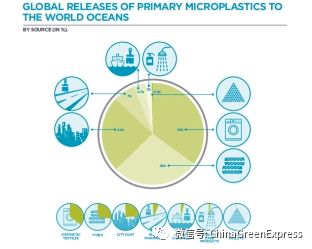
(来源:Boucher Julien, Friot Damien. Primary Microplastics in the Oceans: A Global Evaluation of Sources. IUCN, Gland, Switzerland, 2017.)
文/蓝天 审/赵玉萍 编/angel
参考文献:
[1]Carr, S.A. Sources and dispersive modes of microfibers in the environment. Integr. Environ. Assess. Manag. 2017, 13:466-469.
[2]Boucher Julien, Friot Damien. Primary Microplastics in the Oceans: A Global Evaluation of Sources. IUCN, Gland, Switzerland, 2017.
[3]Essel R., Engel L., Carus M., et al.. Sources of microplastics relevant to marine protection in Germany. Germany: Federal Environment Agency, 2015, 64:1219-1226.
[4]Sunanda Mishra, Chandi charan Rath, Alok Prasad Das. Marine microfiber pollution: A review on present status and future Challenges. Marine Pollution Bulletin., 2019,140:188-197.
[5]Ross P. S., Chastain S., Vassilenko E., et al. Pervasive distribution of polyester fibres in the Arctic Ocean is driven by Atlantic inputs. Nat. Commun., 2021, 12:106.
[6]Constant M., Kerhervé P., Mino-Vercellio-Verollet M., et al.. Beached microplastics in the northwestern Mediterranean Sea. Mar. Pollut. Bull., 2019, 142:263-273.
[7]Burns E., Boxall A.. Microplastics in the aquatic environment: Evidence for or against adverse impacts and major knowledge gaps. Environ. Toxicol. Chem., 2018, 37:2776-2796.
[8] Gasperi J., Wright S. L., Dris R., et al.. Microplastics in air: Are we breathing it in? Current Opinion in Environmental Science & Health 2018, 1:1−5.
[9]Prata J. C.. Airborne microplastics: Consequences to human health? Environ. Pollut., 2018, 234:115−126.
[10]Dris R., Gasperi J., Rocher V., et al.. Microplastic contamination in an urban area: a case study in Greater Paris. Environ. Chem. 2015,12:592-599.
[11] Dris R., Gasperi J., Saad M., et al.. Synthetic fibers in atmospheric fallout: a source of microplastics in the environment? Mar. Pollut. Bull., 2016,104:290-293.
[12] Kosuth M., Mason S.A., Wattenberg E. V.. Anthropogenic contamination of tap water, beer, and sea salt. PLOS ONE, 2018, 13:1-18.
[13]Bal. Bhubaneswari, Ghosh. Shreya, Das. Alok. Prasad. Microbial recovery and recycling of manganese waste and their future application: a review. Geomicrobiology journal, 2019, 36(1): 85-96.
[14]Mohanty, S., Ghosh, S., Bal, et al.. A review of biotechnology processes applied for manganese recovery from wastes. Rev. Environ. Sci. Biotechnol. , 2018, 17:791-811.
[15]Beer S., Garm A., Huwer B., Dierking J., et al.. No increase in marine microplastic concentration over the last three decades—A case study from the Baltic Sea. Sci. Total Environ.,2017,621:1272-1279.
[16]Mohsen M., Wang Q., Zhang L., et al.. Microplastic ingestion by the farmed sea cucumber Apostichopus japonicus in China. Environ. Pollut., 2019, 245: 1071 -1078.
[17]Pauly, J. L. Stegmeier, S. J. Allaart, H. A. Cheney, et al. Inhaled Cellulosic and Plastic Fibers Found in Human Lung Tissue. Cancer epidemiology, biomarkers & prevention, 1998,7(5):419-428.
[18]Athira, N.; Jaya, D.S. The use of fish biomarkers for assessing textile effluent contamination of aquatic ecosystems: A Review. Nat. Environ. Pollut. Technol. 2018, 17:25-34.
[19]Selvaraj, D.; Leena, R.; Kamal, D. Toxicological and histopathological impacts of textile dyeing industry effluent on a selected teleost fish Poecilia reticulata. Asian J. Pharmacol. Toxicol. 2015, 3:26-30.
[20]Almroth, B.C.,Cartine, J., Jönander, C., et al. Assessing the effects of textile leachates in fish using multiple testing methods: From gene expression to behavior. Ecotoxicol. Environ. Saf. 2021, 207:111523.
[21]Lamichhane, G.. Analysis of Microfibers in Waste Water From Washing Machines. Metropolia University of Applied Sciences, 2018.
[22]JC Prata, JL Castro, JP da Costa et al.An easy method for processing and identification of natural and synthetic microfibers and microplastics in indoor and outdoor air. Environ. Sci. Technol. 2020, 54:3288−3296.
[23]Francisco Belzagui, Martí Crespi, Antonio Alvarez, et al. Microplastics' emissions: Microfibers' detachment from textile garments. Environmental Pollution, 2019, 248 :1028-1035.
[24]Belzagui, Francisco, et al.. Textile microfibers reaching aquatic environments: A new estimation approach. Environmental Pollution,2020,265 : 114889.
本文来自“中国绿发会”微信公众号
相关知识
健康离不开膳食纤维
如何在饮食中增加有益的膳食纤维?膳食纤维的好处及来源有哪些?
膳食纤维对身体有哪些好处?
膳食纤维有四大益处
高纤维食物
膳食纤维与健康
膳食纤维对于健康的作用
膳食纤维有什么好处,该怎么补充
膳食纤维好处多,但也不能贪吃呦!
生活中的辐射——辐射无处不在
网址: 微纤维无处不在,危及健康 https://www.trfsz.com/newsview319181.html
推荐资讯



- 1发朋友圈对老公彻底失望的心情 12775
- 2BMI体重指数计算公式是什么 11235
- 3补肾吃什么 补肾最佳食物推荐 11199
- 4性生活姿势有哪些 盘点夫妻性 10428
- 5BMI正常值范围一般是多少? 10137
- 6在线基础代谢率(BMR)计算 9652
- 7一边做饭一边躁狂怎么办 9138
- 8从出汗看健康 出汗透露你的健 9063
- 9早上怎么喝水最健康? 8613
- 10五大原因危害女性健康 如何保 7828